


5 Signs Your Service Website Is Losing Leads (St. Augustine)
If your service business website in St. Augustine isn’t bringing in calls, it’s probably showing one of five common warning signs — and most owners don’t notice until a competitor with a stronger site starts pulling ahead of them in search. Whether you’re an HVAC tech, a landscaper, a cleaning company, or a handyman, these are the same issues we find in nearly every audit we run.
Not because it doesn’t exist. Most businesses have something online at this point. For example – during our research, we noticed that most small businesses have a Facebook Business Page.
The problem is that most local service websites aren’t actually working for you. They’re just sitting there.
In this post, we’re going to break down what a high-performing local service website actually looks like, why it matters for showing up on Google locally, and what separates a site that generates leads from one that quietly does nothing.
Why Your Website Is Your Most Important Local SEO Asset
When someone in St. Augustine searches “roof repair near me” or “best pressure washing St. Johns County,” Google decides which businesses to surface. That decision is based on dozens of signals — your Google Business Profile, your reviews, your backlinks — but one of the biggest factors is your website.
According to Google’s own local ranking guidelines, relevance, distance, and prominence all factor into local search results — and your website directly influences all three.
Google reads your site to understand:
- What services you offer
- Where you serve (St. Augustine, Ponte Vedra, Nocatee, etc.)
- Whether you’re a legitimate, established business
- Whether your site loads fast and works well on mobile
A slow, confusing, or thin website sends the wrong signals — and it costs you rankings before a potential customer ever sees you.
Why Do Local Service Websites Lose Leads?
We’ve audited a lot of local business sites across St. Johns County, and the same issues come up over and over:
1. No clear service area language. If your site never mentions St. Augustine, Fleming Island, or the surrounding areas by name, Google has a harder time associating you with local searches. Your content needs to speak geographically.
2. Slow load times on mobile. More than half of local searches happen on a phone. If your site takes 5+ seconds to load, most visitors are already gone — and Google’s algorithm takes note of that.
3. One vague “Services” page. A single page that lists everything you do with no depth isn’t enough. Each core service deserves its own page with a real description, local context, and a clear call to action.
4. No obvious way to contact you. This sounds basic, but we see it constantly: contact information buried in the footer, forms that don’t work on mobile, or no phone number visible above the fold. Every page of your site should make it effortless to reach you.
5. Generic design that doesn’t build trust. Customers make a judgment about your business in under 3 seconds. A site that looks dated or cluttered signals that you might not be the most professional option — even if you’re the best at what you do.
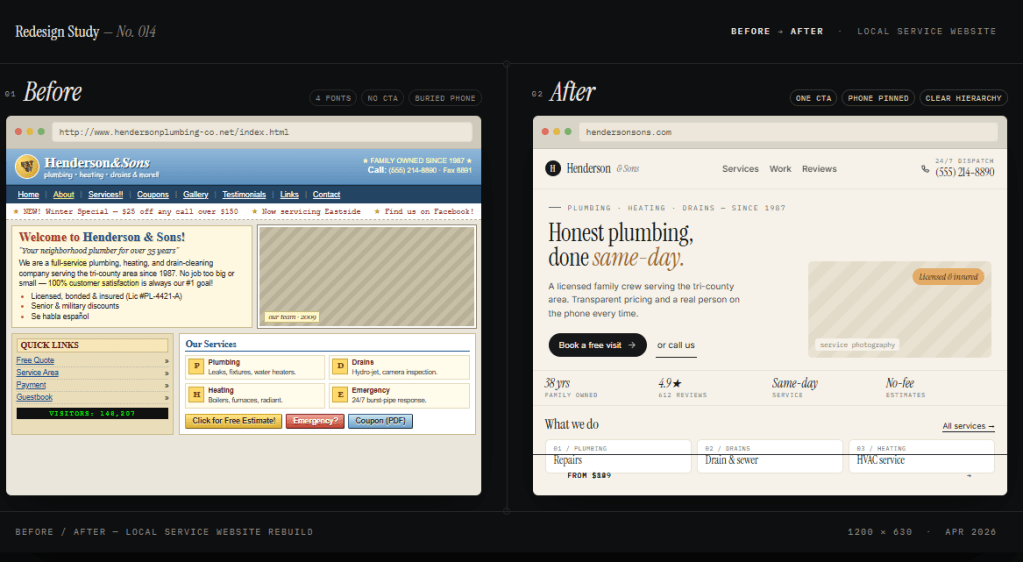
What a High-Performing Local Service Website Looks Like
Here’s the anatomy of a site that actually generates leads:
Clear, Fast Homepage
Your homepage should answer three questions immediately: Who are you? What do you do? Where do you serve? That means a strong headline, a visible phone number or “Get a Quote” button, and a brief service area call-out — all above the fold.
Individual Service Pages
Each major service gets its own dedicated page, optimized for a local keyword. “Pressure Washing in St. Augustine, FL” is a page. “HVAC Repair Near Ponte Vedra Beach” is a page. These pages are how you show up for specific searches.
Trust Signals Throughout
Real photos. Google review counts. Licensing or insurance mentions where relevant. These aren’t extras — they’re conversion tools. A visitor who trusts you is a visitor who calls.
A Blog That Answers Real Questions
Homeowners and business owners search for answers before they search for services. A blog post like “How Often Should You Have Your Gutters Cleaned in Northeast Florida?” positions you as the local expert and pulls in search traffic you’d never get from a service page alone.
Speed and Mobile Performance
A well-built site loads in under 2 seconds, doesn’t shift around as it loads, and looks clean on a 5-inch phone screen. This isn’t a luxury — it’s a baseline requirement for competing in local search.
See It in Action
We built a demo site to show exactly what a clean, lead-generating local service website looks like in practice.

No fluff, no bloated page builders, no stock photos of people shaking hands in suits. Just a clean, fast, conversion-focused site built the way we build every client project.
Ready to See What Your Business Could Look Like?
If your website isn’t generating consistent leads from St. Augustine and the surrounding areas, it’s worth taking a closer look at what’s holding it back.
We offer a free SEO audit that scores your site’s performance, identifies gaps, and shows you exactly where you’re leaving leads on the table.
Your website is one of the strongest signals Google uses to understand what your business does and where it operates. A well-built site reinforces your Google Business Profile, improves your local rankings, and converts visitors into actual leads.
Most local businesses start seeing meaningful movement within 3–6 months. Quick wins — like fixing your Google Business Profile and improving page speed — can show results faster. Sustained rankings come from consistent content, backlinks, and on-page optimization over time.
A high-performing local service site loads fast on mobile, clearly states your service area, has individual pages for each service, and makes it effortless to contact you. Trust signals like reviews, licensing info, and real photos make a significant difference in conversion.
Yes — individual service pages are one of the highest-impact changes a local business can make. Each page targets a specific keyword (like “pressure washing St. Augustine”) and gives Google more content to index, which means more opportunities to rank.
It depends on scope, but a well-built local service site typically ranges from $1,500–$4,000. That includes design, development, basic on-page SEO, and mobile optimization. Ongoing care plans for maintenance and SEO are usually $100–$300/month.
Yes — we built a live demo specifically for this. It shows a clean, conversion-focused service business site with all the right elements in place. View the demo here.